





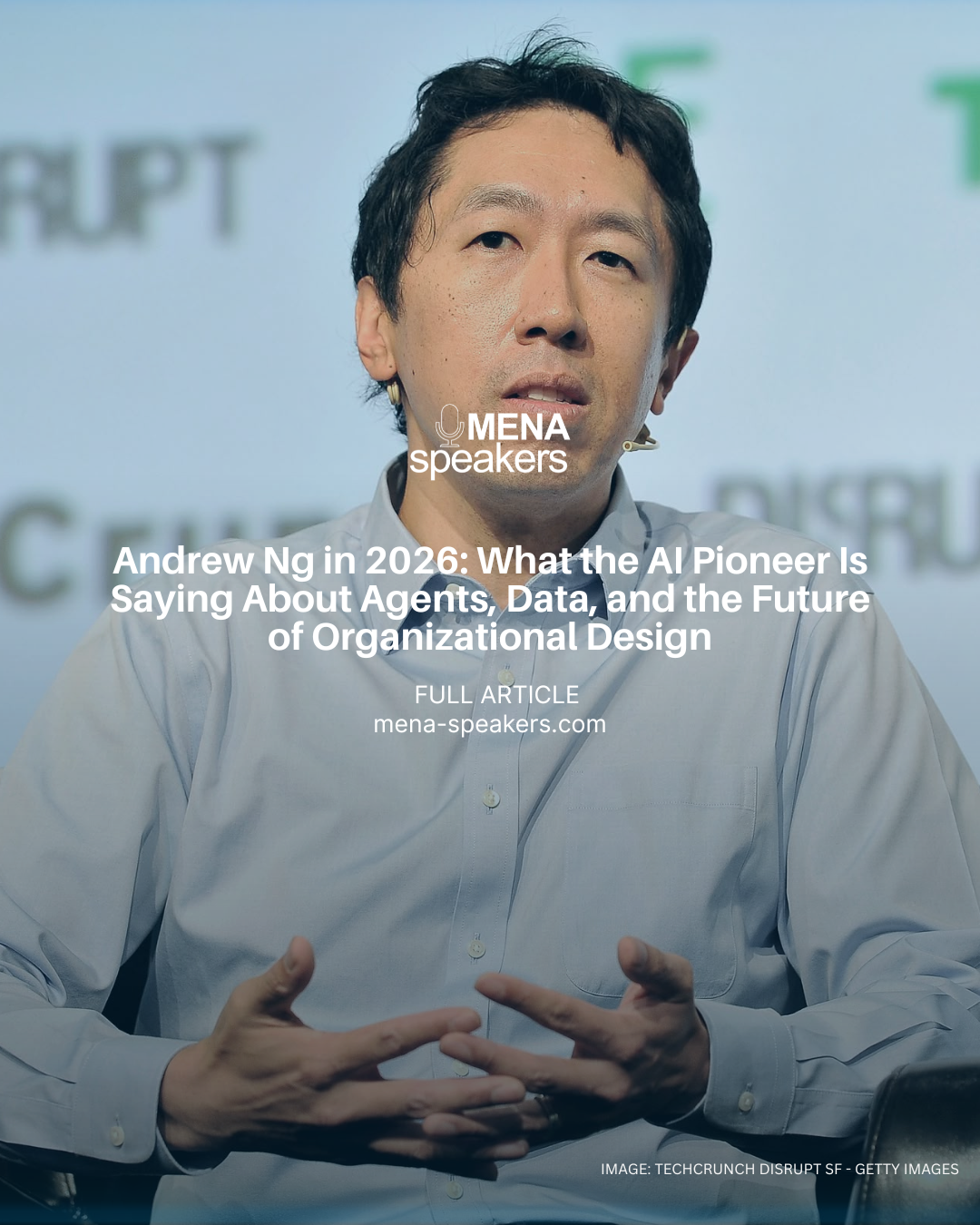
From agentic AI to enterprise data architecture, Andrew Ng's current thinking is setting the agenda for how business leaders across the MENA region should approach AI strategy. Here is where his focus stands today.
Why Andrew Ng's Current Thinking Matters More Than His Biography
Few figures in the global artificial intelligence landscape command the breadth of institutional influence that Andrew Ng currently holds. As founder of DeepLearning.AI, Managing General Partner at AI Fund, Executive Chairman of LandingAI, Co-Founder and Chairman of Coursera, and Adjunct Professor at Stanford University, his positions span research, venture capital, enterprise application, and education simultaneously. For event organizers, corporate leaders, and program committees across the MENA region evaluating him as a keynote speaker, the more consequential question is not where he has been, but where his thinking stands in 2026 and why it is directly relevant to the decisions their audiences are navigating now.
Recent Keynote Appearances and Public Platforms
Andrew's 2026 speaking calendar reflects his continued position at the center of the global AI conversation. He is confirmed as part of the headline keynote panel at Ai4 2026, widely regarded as the largest AI conference in the United States, taking place August 4 to 6 at The Venetian in Las Vegas. In a rare joint appearance, Andrew will share the main stage with Geoffrey Hinton and Fei-Fei Li for a session addressing frontier AI research, human-centered innovation, and the governance challenges accompanying accelerating global AI adoption. The pairing of three figures whose individual contributions have defined successive eras of the field makes this among the most anticipated keynote sessions of the year.
Earlier in 2026, Andrew returned for a second consecutive appearance at LangChain's Interrupt conference, an event oriented specifically toward AI agent development and enterprise deployment. His fireside conversation there has become one of the most referenced discussions of the year among senior AI practitioners, largely for the directness with which it addressed the operational realities organizations face as coding automation and agentic workflows move from experimentation into production.
What Andrew Ng Is Focused On Right Now
Several consistent themes run through Andrew's recent keynotes, public interviews, and The Batch, his long-running weekly newsletter that remains among the most widely read publications in the AI field.
The structural advantage of small, technically empowered teams.
Andrew has been notably direct about a shift he observes across high-performing AI organizations: compact teams of between one and ten technically skilled generalists, given broad latitude and modern AI tooling, are outpacing larger, more conventionally structured divisions. His argument is that as AI agents accelerate software development, the true bottlenecks shift elsewhere: into legal review, strategic decision-making, marketing, and design. The implication for organizational leaders is that the unit of competitive advantage is no longer headcount but team architecture.
Coding agents as the fastest-moving category in AI.
While Andrew is characteristically cautious about overstatement, he has identified coding agents as a genuine exception to the broader tendency toward incremental progress in AI. He has described actively reconfiguring his own professional workflow across multiple tools within a matter of months, not as a demonstration of novelty but as a practical response to the pace of genuine capability advancement in this specific category.
Data architecture as the defining enterprise challenge.
One of the most consistently repeated points in Andrew's 2026 communications is that the unstructured data problem now facing most large organizations represents a challenge of comparable magnitude to the structured data investments of the previous two decades: larger in scope, more complex in execution, and more consequential in outcome. Documents, audio, images, and video must be prepared so that AI agents can reason over them effectively. He projects this rearchitecture will represent multi-billion-dollar undertakings across industries in the years ahead, a view that carries direct relevance for finance, logistics, telecommunications, and government sectors currently accelerating digital transformation across the MENA region.
Preserving optionality as a strategic discipline.
Given the pace at which leading AI models and development tools continue to evolve, Andrew has been explicit about deliberately avoiding long-term vendor contracts, even when offered meaningful discounts, in favor of preserving organizational flexibility. For executive and board-level audiences evaluating multi-year AI investment commitments, this is among the most practically consequential positions he currently holds.
Redefining work rather than eliminating it.
Andrew has pushed back directly against predictions of AI-driven mass unemployment, arguing that the more accurate and useful frame is one of role redefinition: professionals across marketing, product development, and operations are increasingly expected to build alongside engineers rather than simply commission work from technical teams. The organizations that thrive will be those that invest in developing this capacity broadly rather than concentrating it narrowly.
Growth over efficiency as the primary AI mandate.
Across multiple recent keynotes, Andrew has urged business leaders to orient AI strategy primarily around top-line growth rather than cost reduction alone. His reasoning is structurally sound: efficiency gains have a practical ceiling, while AI-enabled products, services, and customer experiences are genuinely unbounded in their potential.
Why This Matters for MENA Event Organizers and Business Audiences
What distinguishes Andrew's current public positioning from the broader AI commentary landscape is its operational specificity. Rather than offering broad technological futurism, his recent talks are grounded in tested, actionable guidance: how enterprises should restructure teams, how they should approach vendor negotiations, how they should measure return on AI investment, and where they should concentrate strategic attention in a field that is changing faster than most organizational planning cycles can accommodate.
This makes him a particularly valuable keynote speaker for audiences that have moved past the question of whether to invest in AI and arrived at the more demanding questions of how, at what pace, and with what organizational architecture. Those are precisely the conversations driving leadership agendas across the region's most consequential sectors.
Booking Andrew Ng or a Speaker on Comparable Themes
As demand grows across the region for keynote speakers capable of translating frontier AI developments into grounded business strategy, MENA Speakers works with event organizers to identify and secure the right voice for each specific audience, whether that is Andrew Ng directly or a speaker whose expertise maps precisely to the themes of agentic AI, enterprise data strategy, and organizational design for an AI-accelerated environment.
Organizations planning conferences, leadership summits, or executive briefings are invited to connect with the MENA Speakers team to discuss availability and topic alignment.
Sources: Ai4 2026 conference announcements; LangChain Interrupt 2026 coverage; Andrew Ng's public writing via The Batch, DeepLearning.AI's weekly newsletter.
MENA Speakers is a full-service speaker management bureau and the leading keynote speaker sourcing partner for major events across the GCC and MENA region.