




Crowd work has moved from comedy clubs to corporate conference stages across the MENA region. Here is why event planners are treating it as a strategic programming decision, not an entertainment flourish.
Beyond the Script: Defining Crowd Work
Crowd work refers to the spontaneous, real-time interaction between a performer and their live audience. Unlike scripted material, it is improvised in the moment, drawing directly from audience responses, individual participants, and the unrepeatable conditions of a specific room on a specific day. It may take the form of a comedian riffing from an unexpected audience response, a keynote speaker weaving live input into their narrative arc, or an emcee recalibrating their delivery in real time as the energy of a room shifts.
While crowd work is most closely associated with stand-up comedy, its application has expanded considerably. Corporate keynote speakers, conference moderators, panel facilitators, and professional masters of ceremony across the MENA region now regularly incorporate audience engagement techniques drawn from crowd work practice. For event planners, this shift carries meaningful programmatic implications.
Why Demand for Crowd Work Is Rising Across Live Events
Several converging forces have elevated crowd work from a performance technique to a strategic consideration in event programming.
Audiences have recalibrated their expectations of authenticity. In a media environment saturated with pre-produced, algorithmically optimized digital content, live and unscripted moments carry a quality that recorded formats cannot replicate. Research by sociologist Erving Goffman on the dynamics of face-to-face interaction established decades ago that co-present encounters produce a quality of engagement that mediated communication structurally cannot achieve. Crowd work is, at its core, an intensification of this dynamic: it exists only in that room, at that moment, between those specific people.
Shared laughter creates measurable social bonds. Professor Robin Dunbar of Oxford University, whose research on laughter and social bonding demonstrates that communal laughter triggers the release of endorphins and strengthens group cohesion, provides a compelling evidence base for why well-executed crowd work produces an audience that is not merely entertained but genuinely connected. For corporate event planners, this is not a peripheral benefit; it is a direct contribution to the networking and relationship-building objectives that most conferences are formally designed to achieve.
The appetite for genuine two-way engagement has intensified. As organizations move away from presentation-heavy conference formats, the demand for keynote speakers and event hosts capable of creating genuine dialogue rather than delivering one-directional monologues has grown considerably. Crowd work directly addresses this shift, transforming passive attendees into active participants and fundamentally altering the psychological contract between a performer and a room.
Unscripted moments generate disproportionate post-event reach. Event organizers increasingly recognize that a well-executed crowd work exchange is among the most shareable content an event can produce. Its organic, unrepeatable quality makes it precisely the kind of material that extends an event's reach well beyond those physically present.
Why Crowd Work Is Among the Most Difficult Skills in Live Performance
Despite its apparently spontaneous character, crowd work is widely regarded by performance practitioners as one of the most technically demanding skills in live performance. Keith Johnstone, whose foundational text Impro: Improvisation and the Theatre remains the definitive practitioner's reference on the subject, argues that truly skilled improvisation requires the performer to dismantle the instinct toward control entirely, operating instead from a state of radical responsiveness to the other. That capacity, developed over years of deliberate practice, is what separates a crowd work specialist from a performer who merely attempts it.
Competent execution requires the following.
Improvisational fluency. Performers must formulate responses in real time, with no script and no rehearsable material to fall back upon. The cognitive load this places on a performer is substantially higher than scripted delivery.
Emotional intelligence and social reading. The capacity to gauge audience mood, identify which individuals to engage and precisely how to engage them, and read the collective energy of a room demands a level of social awareness that cannot be taught through conventional performance training alone.
Mastery of timing and pacing. A crowd work moment executed with poor timing can destabilize an event's energy; the same exchange, timed with precision, can elevate it significantly. This distinction is rarely visible to an audience but is consistently determinative of whether a crowd work performance succeeds.
Resilience under uncertainty. Not every audience interaction proceeds as a performer anticipates. The ability to absorb an unexpected or unfavorable response and recover the room's confidence without breaking composure is a skill that distinguishes the most accomplished practitioners from the merely competent.
What Mastery Looks Like in Practice
Within the MENA region, a small number of performers have developed crowd work into a genuine professional discipline rather than an occasional technique.
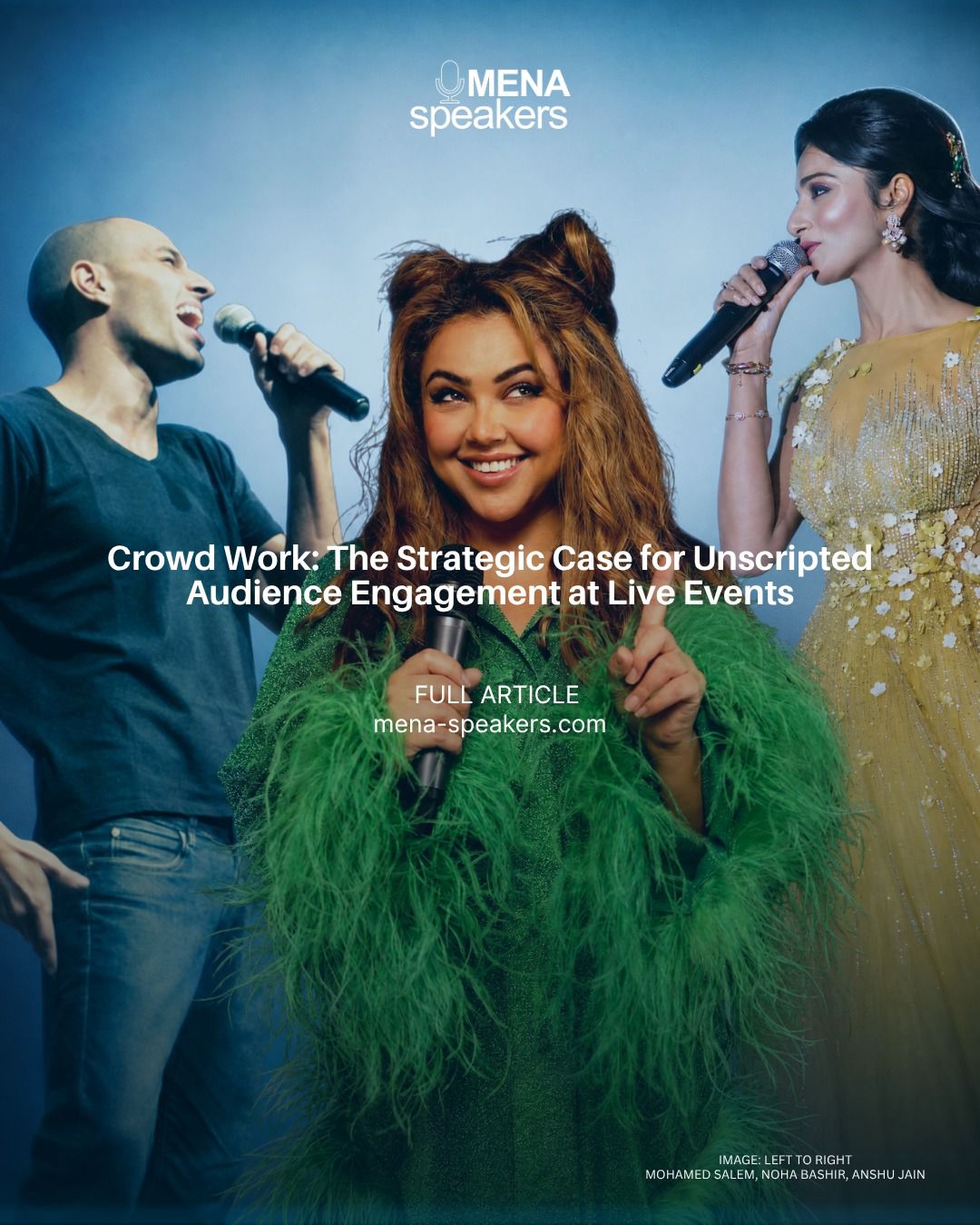
Mohamed Salem has built a reputation across the region specifically on his capacity to improvise at scale, transforming unrehearsed audience exchanges into material of genuine comedic and emotional weight. His performances demonstrate what systematic crowd work expertise looks like when applied with consistency across events of varying scale, format, and audience composition.
Noha Bashir has developed a performance practice in which a single audience interaction becomes the structural foundation of an extended set. The precision with which she constructs comedic architecture from entirely unscripted material illuminates exactly what separates crowd work mastery from its imitation, and why the skill, when genuinely present, is immediately distinguishable to any trained observer of live performance.
Anshu Jain, whose credits include serving as International Master of Ceremonies at the FIFA World Cup 2022, represents the application of these skills at the highest level of global event production. Reading and responding to rooms of thousands across cultural and linguistic contexts, with the fluency and composure that only deep expertise produces, her work defines what professional crowd work looks like when the stakes are at their highest.
Scripted Performance and Crowd Work: Understanding the Distinction
For event planners curating a live event lineup, the distinction between scripted performance and crowd work is a practical and programmatic one.
Scripted performances are developed in advance, rehearsed to a consistent standard, and reproducible across events. They offer predictability, control, and the assurance that a performer can deliver a precisely calibrated message regardless of audience conditions on the day.
Crowd work is constitutively unrepeatable. It cannot be rehearsed because it depends entirely on the specific individuals present in a specific room under specific conditions. This is simultaneously its primary risk and its most significant source of value: no two crowd work performances, even with the same performer, will unfold identically. For event planners managing high-stakes programs, this distinction must inform how crowd work is positioned within an overall event architecture, complementing scripted elements rather than replacing them where precision of message is paramount.
Crowd work has established itself as a substantive strategic consideration in contemporary live event programming, not a passing entertainment trend. For event planners and organizations across the MENA region seeking to elevate audience engagement at conferences, corporate gatherings, galas, or large-scale productions, booking keynote speakers and event hosts with genuine crowd work expertise offers a proven pathway to the kind of dynamic, memorable experience that endures in an audience's professional memory long after the event concludes.
MENA Speakers connects event planners and organizers across the region with professional speakers, hosts, and performers whose expertise in live audience engagement is verified, demonstrable, and matched precisely to the demands of each event.
MENA Speakers is a full-service speaker management bureau and the leading keynote speaker sourcing partner for major events across the GCC and MENA region.