




MENA will spend $169B on tech in 2026, yet few firms move AI past pilots. What separates pilots from enterprise-wide, governed AI.
The AI Pilot Problem
The Middle East is not lagging behind on artificial intelligence. If anything, it is setting the pace. Middle East CEOs report some of the highest rates of AI adoption in the world, with widespread deployment already underway across demand generation, customer service, and support functions. Regional confidence in AI is outpacing the global average too: 65% of MENA CEOs say they are actively pushing their organisations to embrace generative AI, compared with 61% globally, and 54% consider advanced generative AI mission-critical for staying competitive.
Yet adoption and impact are not the same thing.
Globally, McKinsey's most recent Global AI Survey found that while 88% of organisations now use AI regularly in at least one business function, only around a third have moved past the experimentation and piloting stages into enterprise-wide scaling, and just 7% report AI fully scaled across their organisation. BCG's research paints an equally sobering picture: 60% of companies are seeing "hardly any material value" from their AI investment, and 74% have yet to show tangible returns at all.
That gap between adoption and value is not a technology problem. The tools work. It is a leadership problem. Companies collect wins in isolated teams, then struggle to translate those wins into enterprise-wide change.
Why Pilots Stall
Pilots rarely fail to scale because the underlying models are weak. They stall for far more mundane reasons: data trapped in departmental silos, no single owner accountable for the initiative's success, governance bolted on after deployment rather than designed in from day one, and pilot teams that have proof of concept but no mandate to change how the rest of the business actually operates.
BCG frames this as the "10-20-70" principle: AI success is roughly 10% algorithms, 20% data and technology, and a full 70% people, processes, and cultural transformation. Organisations that treat AI as a purely technical rollout are solving for the smallest part of the problem. The result is a pattern familiar to almost every enterprise leader in the region: a promising proof of concept, a glowing demo for the board, and then nothing that survives contact with enterprise scale.
What Scaling Actually Requires
Scaling AI is an operating model change, not an IT project. It needs an executive owner with real authority to redesign workflows, not just approve budgets. It needs clean, governed data as the foundation, since fragmented or low-quality data is consistently cited as the single biggest technical barrier to moving past the pilot phase. And it needs clear, agreed metrics so leadership can see whether an initiative is actually delivering value, rather than simply generating activity.
Most importantly, it needs trust. Employees will not rely on tools they do not understand, and boards will not keep funding systems they cannot govern.
This is where human leadership carries the day. Across the region, governments are pushing adoption hard through national AI strategies and major infrastructure investment, and the private sector now has to match that pace with equally serious governance. The companies that pull ahead will be the ones that treat scale and governance as a single problem to solve together, not two separate workstreams running on different timelines.
Learning from a Global Voice on Creativity, Innovation & AI
If BCG's "70% problem" is right, that scaling AI is mostly about people, culture, and how humans actually work alongside the technology, then the leaders who solve it will be the ones who invest as much in creative thinking as they do in infrastructure.
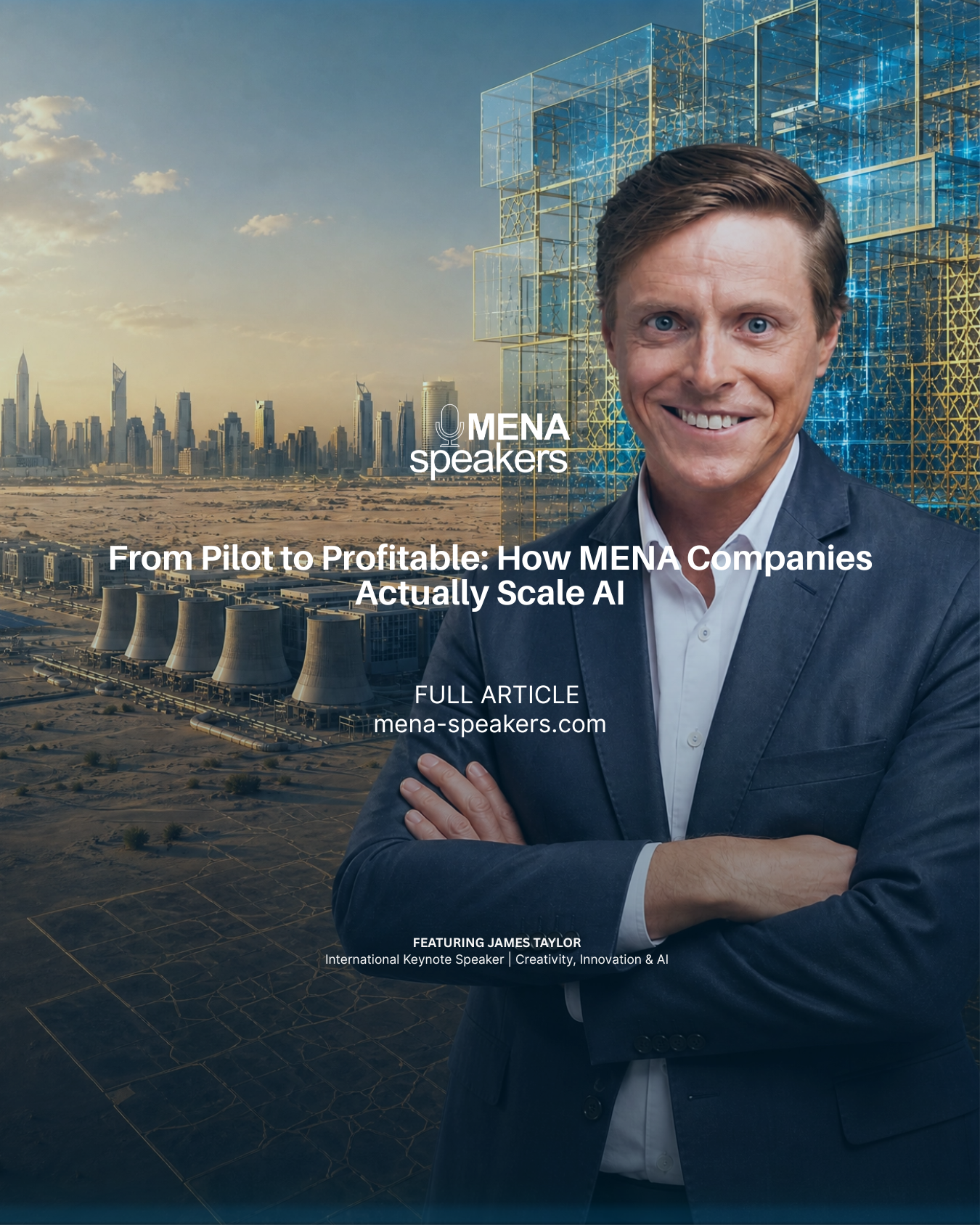
Few speakers make that case more compellingly than James Taylor, an award-winning entrepreneur, bestselling author, and globally recognised keynote speaker on creativity, innovation, and artificial intelligence.
With more than two decades advising CEOs, entrepreneurs, and leadership teams from Silicon Valley to Singapore, James helps organisations move past AI buzzwords and into practical competitive advantage. His keynotes make the case that creativity, not technical fluency alone, is what separates companies that meaningfully scale AI from those stuck running pilots on repeat, because redesigning a workflow, rethinking a customer experience, or reimagining how a team works are fundamentally creative acts, not technical ones.
For event planners and leadership teams preparing their organisations for the AI era, James's sessions offer a practical, non-technical look at how AI is reshaping leadership, decision-making, and productivity, and what leaders need to do next to keep their people, not just their pilots, moving forward.
Book James Taylor to speak at your next conference, leadership offsite, or innovation summit, and give your audience the creative and leadership tools that turn AI adoption into AI advantage. Enquire about his availability through MENA Speakers at info@mena-speakers.com or +971 54 995 4166.
The Road Ahead
The momentum behind this shift is measurable. Gartner forecasts that IT spending across the Middle East and North Africa will reach $169 billion in 2026, an 8.9% increase on 2025, with AI-optimised infrastructure and data centre systems identified as the fastest-growing segment of that investment. AI now sits at the centre of the region's technology strategy, not on the periphery of it.
The organisations that pull ahead will not be the ones that ran the most pilots. They will be the ones that scaled responsibly, governed clearly, and put people at the centre of the change from the very beginning.
The tools are ready. The question every MENA leadership team should be asking is whether their organisation is ready too.
MENA Speakers connects event planners and organisations across the region with keynote speakers whose expertise in AI, digital transformation, and governance is proven, current, and matched precisely to the demands of your event.
Contact us at info@mena-speakers.com or +971 54 995 4166.