Most events educate, few truly transform. The gap between the two is deliberate experience design, and it begins long before the first speaker takes the stage.
The Problem: Logistics Without Strategy
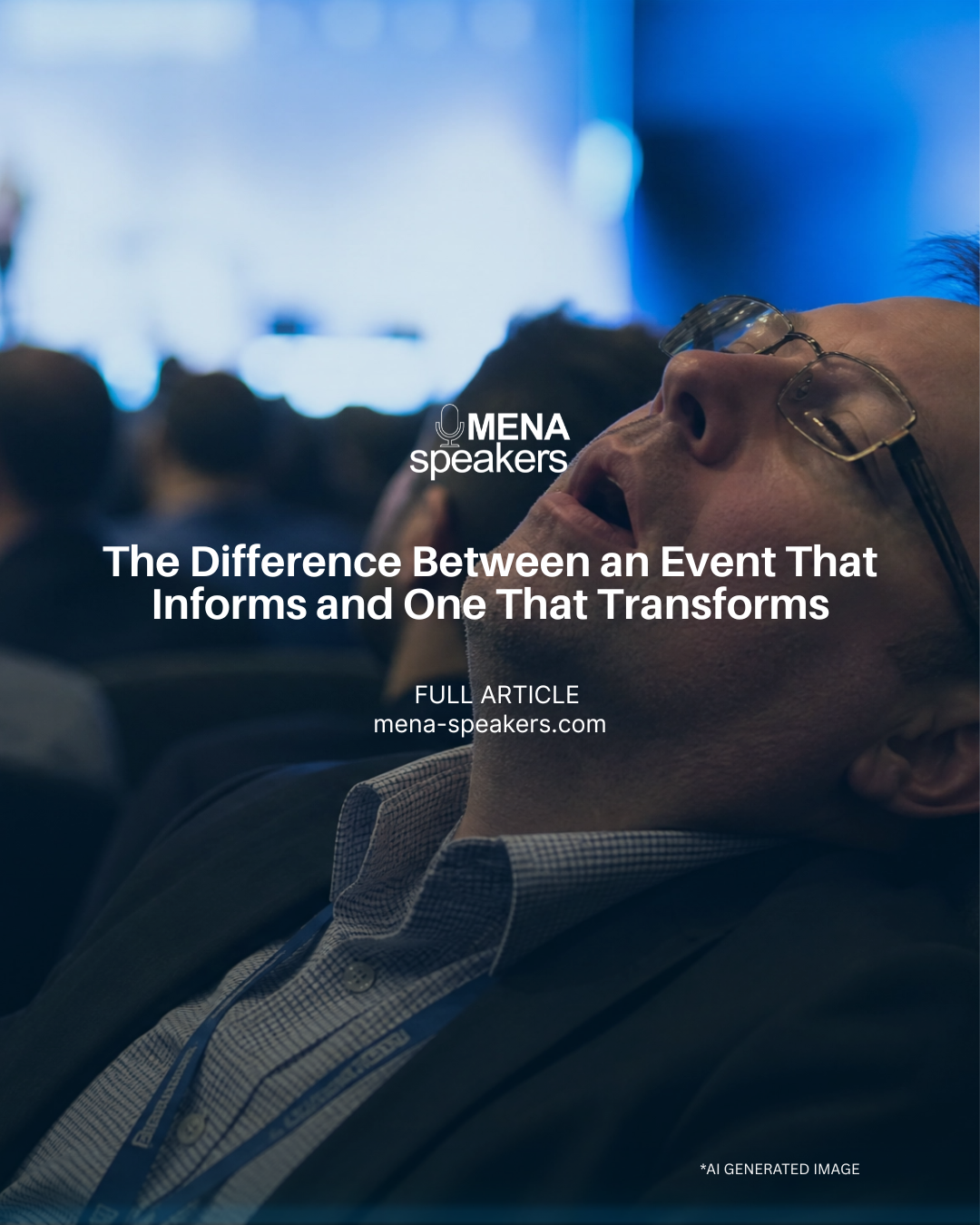
There is a meaningful distinction between an event that informs its attendees and one that transforms them. Both can be well-organized, well-attended, and professionally delivered. Both can generate positive feedback. Yet one leaves its audience largely unchanged, while the other shifts something, a perspective, an assumption, a way of approaching a consequential problem. The former is a logistical achievement. The latter is a strategic one.
The gap between them is rarely accidental. It is designed or it is not.
Event planning, at its most visible, is a discipline of execution. Venues, schedules, audio-visual requirements, travel logistics, these are the elements that consume the majority of planning resources, and rightly so. Their failure is immediately apparent. Their success, however, is not sufficient.
What is considerably less visible and correspondingly less often addressed, is the layer of strategic thinking that determines whether an event merely runs smoothly or genuinely resonates. This is the layer concerned not with how an event is delivered, but with what it is designed to produce: what the audience should experience, what ideas they should encounter, and what they should understand differently upon leaving.
The academic framework that best captures this distinction is Jack Mezirow's theory of transformative learning, which identifies the critical difference between additive learning - receiving new information within an existing framework and transformative learning, in which the framework itself is altered. Most events, by design and by default, produce the former. The rare event that produces the latter does so deliberately.
When event organizers are engaged after the foundational decisions have already been made, this strategic layer has typically been bypassed. The program has not necessarily been designed.
Where Speaker Selection Fits In
Of all the elements that constitute an event's strategic architecture, speaker selection carries the greatest potential to determine whether an event informs or transforms. This is not simply because keynote speakers occupy prominent positions in the program. It is because a genuinely well-chosen keynote speaker does something that no venue, no production value, and no networking format can replicate: they introduce an idea the audience has not considered and, in doing so, expand what that audience believes to be possible.
This is further illuminated by Daniel Kahneman's peak-end rule - the well-documented finding that individuals do not evaluate experiences by averaging them across their duration, but by their most intense moment and their conclusion. Applied to event programming, this carries a precise implication: the keynote speaker who produces the single most intellectually challenging moment of the day will disproportionately define how the entire event is remembered and assessed. Speaker selection is therefore not one element of event design among many, it is the variable with the highest leverage over the experience as a whole.
Across the MENA region, where events increasingly serve as forums for some of the most consequential conversations in business, governance, and culture, this potential is consistently underutilized. The voices placed on stage are frequently those best positioned to confirm existing thinking rather than challenge it.
The Solution: Experience Design, Not Just Programming
The transition from informing to transforming begins with a reorientation of the questions asked at the planning stage. Rather than asking "who is available and appropriate for this event," the more productive and strategically precise question is: "what does this audience need to encounter in order to leave thinking differently?"
That question carries implications not only for keynote speaker selection, but for the entire architecture of the event experience, the sequencing of sessions, the design of the agenda's flow, the moments of structured exchange between attendees, and the deliberate creation of space in which ideas can take root. Every programmatic element either supports or undermines the transformation the event is designed to produce.
Professional speaker management is the function best positioned to bridge this gap. At MENA Speakers, speaker sourcing is approached as one component of this broader design question. MENA Speakers' network of prominent Arab figures and regional thought leaders is extensive, but the value we bring is not simply access to that network. It is the capacity to identify, within it, the voices most likely to produce the kind of encounter a specific audience needs: one that challenges assumptions, introduces genuinely new perspectives, and creates the conditions under which consequential thinking can occur.
The Standard Worth Holding
The most enduring measure of an event's success is not the attendance figure or the satisfaction score gathered at the exit. It is whether, weeks or months later, attendees can identify something they heard, encountered, or reconsidered that continues to influence the way they work, lead, or think.
Research supports the difficulty of achieving this through conventional programming. The Ebbinghaus Forgetting Curve, one of the most replicated findings in cognitive psychology, demonstrates that without active reinforcement, individuals forget the majority of new information within days of receiving it. What endures is not content, but encounter: the moment of genuine intellectual disruption that reorganizes how a person sees a problem they have been carrying for years.
That is the standard a well-managed keynote speaker program can meet. It requires treating event design and speaker selection within it, as a strategic exercise from the outset, not an administrative function managed under pressure and time constraint.
The Takeaway
The difference between an event that informs and one that transforms is rarely a matter of budget or production quality. It is a matter of intentionality, of asking the right questions early enough to allow the answers to shape the program, and of engaging the right speaker management expertise before decisions are made, not after.
MENA Speakers works with organizations across the region to design keynote speaker programs that go beyond filling an agenda, building the kind of experiences that attendees carry with them long after the event concludes.
MENA Speakers is a full-service speaker management bureau and the leading keynote speaker sourcing partner for major events across the GCC and MENA region.