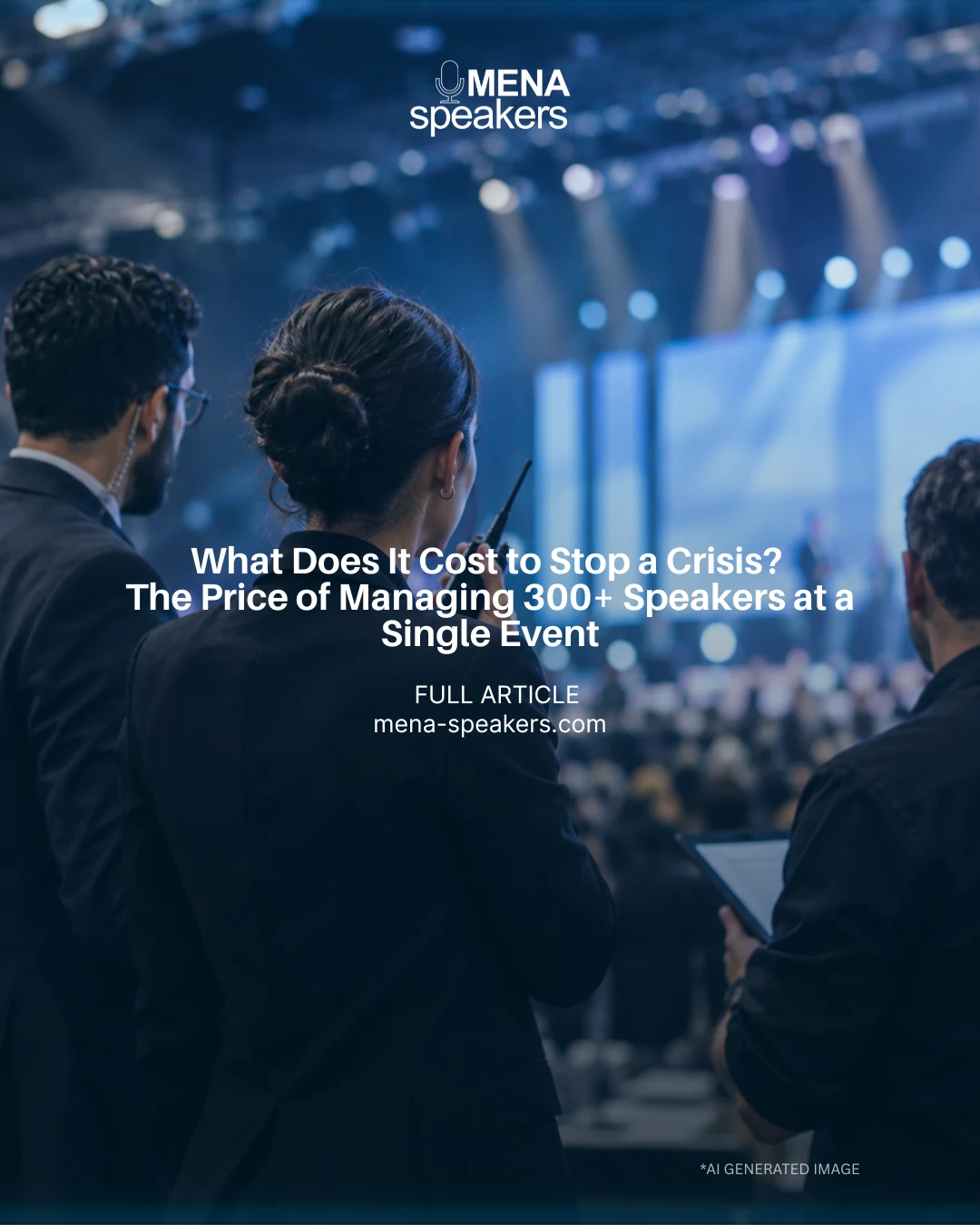
Most organisers only ask one version of this question, and they ask it too late: what did that crisis just cost us? The more useful question, and the one almost nobody budgets for in advance, is what it would have cost to stop it before it started.
The Scale the GCC Is Now Operating At
That question matters more in this region than almost anywhere else, because Gulf events have stopped operating at a scale where informal, ad hoc speaker coordination is survivable. LEAP, Saudi Arabia's flagship technology event, hosted more than 700 speakers from 50 countries across 11 stages in its 2023 edition alone, and more than 1,000 speakers in 2025. Events of this size are now routine across Riyadh, Dubai, and Doha, not the exception. At 200, 500, or 1,000-plus speakers, a single missed contract clause, a single visa delay, or a single protocol oversight with a government guest of honour is no longer a contained problem. It is a visible one, on a stage, in front of an audience and a region's media.
What a Speaker Crisis Actually Costs
The costs involved are more concrete than most organisers assume going in. When a Canadian city cancelled a single keynote speaker over public backlash, the final bill came to roughly $6,200 in non-refundable deposit and tax, on a speaker who was only ever going to cost $10,000 to begin with, a nearly two-thirds loss on a booking that never even happened. At the other end of the scale, one concert promoter reported losing close to SG$1 million on a single last-minute cancellation, once lost ticket revenue, sunk production costs, and vendor obligations were accounted for.
The entertainment and events insurance industry has built an entire product category, non-appearance insurance, around exactly this exposure, because the recognised causes of a speaker or performer failing to appear span a genuinely wide list: illness or injury, adverse weather, travel disruption, security and terrorism concerns, communicable disease, and simple unavailability. None of these are exotic risks. At 300-plus speakers, drawn from dozens of countries and time zones, the odds that at least one of them materialises on any given event are not low. They are close to certain.
And the financial cost is often the smaller half of the exposure. The larger one is reputational: a visibly empty stage slot, a mishandled VIP introduction, or a session that collapses mid-panel because no one owned the contingency plan reflects directly on the organisation whose name is on the event, not on whichever vendor happened to be holding that piece of the puzzle when it broke.
Why the Real Risk Is Ownership, Not the Speakers Themselves
The instinctive response to that risk is usually to add more oversight: another coordinator, another checklist, another committee sign-off. Research on project delivery suggests this almost always makes things worse, not better. Project management analysis has found that the more people formally listed as responsible for a task, the longer it takes to complete, and the lower the quality of the final output. When ownership is distributed across multiple internal teams, agencies, and vendors, each party optimises for their own slice of the event rather than the outcome as a whole, and critical information gets trapped in silos between the handoffs where no single person is actually watching.
The fix that keeps showing up in delivery research is strikingly consistent: a single, named, accountable owner for the entire process, not a committee. In one documented case, a programme with fragmented governance and unclear ownership cut its delivery risk by 40% within eight weeks simply by re-establishing a single source of truth and a single point of accountability. The same logic applies directly to speaker management at scale: when sourcing, contracting, protocol, logistics, and on-site execution all report through one accountable owner instead of being split across departments, procurement, and multiple vendors, problems surface while they are still small enough to fix quietly, instead of large enough to become visible from the audience seats.
What Single Ownership Looks Like in Practice
In practice, this means one party is accountable for the entire lifecycle of the speaker programme, not just one segment of it:
Before the event, MENA Speakers understands the event's objectives and audience, proposes and selects the right speakers for the room, manages every contract and agreement, and builds the full schedule of sessions and talks around realistic logistics, not aspirational ones.
On event day, MENA Speakers manages speaker arrival and backstage coordination, confirms every stage and technical requirement is actually ready rather than assumed ready, and controls the live flow of the programme, so that when something does shift, there is one person with the authority and the context to adapt it immediately rather than a scramble to find out who's responsible.
After the event, MENA Speakers closes the loop: gathering evaluations, documenting what worked and what didn't, and feeding those lessons into the next programme instead of starting from zero again.
This is also where the budget conversation has to happen honestly and early, not after a crisis has already forced an emergency spend. A realistic view of current speaker fees across the region is one of the simplest ways to avoid two of the most common failure points: under-budgeting a programme to the point where backup options don't exist, and over-paying for a name without the operational support to manage the risk that comes with booking them. MENA Speakers' fee benchmark guide gives organisers that starting point before negotiations, not after.
What This Looks Like When It Works
Across major events in the region, from national science and innovation festivals to international tech conferences, government-attended healthcare exhibitions, and heritage-sector forums with royal patronage, the pattern holds: the events that run smoothly are consistently the ones where speaker management sat with a single accountable owner from the first planning call through the post-event report. Even recovery situations, where an event has already run into trouble before doors open, follow the same logic: the fastest way back to a stable programme is a single team realigning the speaker lineup, session order, and messaging, not another layer of internal sign-off.
See how this plays out across real events, including a national innovation festival, a global leadership forum, and a high-stakes government-attended exhibition, on our speaker and protocol management case studies page.
The Real Question to Ask Before the Next Event
Most organisations never price out crisis prevention because it's invisible when it works. There is no line item for "the visa delay that didn't become a stage gap" or "the protocol breach that never happened because someone caught it in rehearsal." But the absence of a crisis is not luck. It is the direct, measurable output of one party being fully accountable for 200-plus moving pieces, rather than a dozen parties each being partially accountable for one.
The question worth asking before your next major event isn't what a crisis would cost you. It's what it costs to make sure you never have to find out.
Planning an event with 300 or more speakers?
Contact MENA Speakers at info@mena-speakers.com or +971 54 995 4166 to discuss single-owner speaker and protocol management for your next event.