


The customer experience field is being reshaped faster than almost any other function in the enterprise. According to Salesforce's State of Service: AI Agents Edition, a May 2026 survey of over 3,000 service professionals, adoption of AI agents in customer service organisations rose from 39% to 66% in a single year, with 85% of service organisations now using at least one form of AI. Gartner goes further, projecting that agentic AI will autonomously resolve 80% of common customer service issues by 2029, up from roughly 14% today.
Routine service, answering the standard question, resolving the predictable complaint, processing the simple request, is becoming automated and cheap at a pace few leaders anticipated even two years ago. That raises a genuinely difficult question for CEOs and CX leaders alike: if machines handle the basics faster and cheaper than any human team ever could, what is actually left for people to do?
The Trust Gap AI Hasn't Closed
The honest answer, according to the data, is that AI has not yet earned the customer's full confidence, even as adoption accelerates. A March 2026 survey of 2,000 consumers by Ada and NewtonX found that only 24% said their most recent AI customer service interaction was fully resolved by AI alone. Separately, 64% of customers say they wish companies would stop using AI in customer service altogether, a striking counterweight to the adoption curve executives are celebrating in board decks.
This is the gap that defines the next decade of customer experience strategy. Speed and availability are becoming commoditised: every competitor can now offer instant, 24/7 responses. What AI agents cannot yet replicate is judgment under ambiguity, genuine warmth, and the kind of discretionary, human decision-making that turns a transactional interaction into a relationship. Speed becomes a given. Emotional intelligence becomes the differentiator, and the organisations that win will be the ones that pair efficient AI with human-grade hospitality, judgment, and trust at exactly the moments that matter most.
What the Ritz-Carlton Standard Still Teaches
Few service standards in the world are studied more closely than The Ritz-Carlton's. The brand built its global reputation on a deceptively simple idea, captured in its Gold Standards: the Credo, the Motto ("We Are Ladies and Gentlemen Serving Ladies and Gentlemen"), the Three Steps of Service, and the Employee Promise, all built around anticipating guest needs before they're voiced, not merely reacting to them once they're raised.
The most famous expression of that philosophy is The Ritz-Carlton's $2,000 empowerment rule: any employee, at any level, can spend up to $2,000 per guest, per incident, to resolve a problem on the spot, without needing a manager's sign-off. As co-founder Horst Schulze has explained, the rule was never really about the dollar figure. It was a declaration that frontline staff could be trusted with real authority, and that trust, not a script, is what produces service people actually remember. That empowerment model, paired with intensive training on when and how to use it, is precisely why The Ritz-Carlton's service culture has outlasted every competitor that tried to copy the surface-level gestures without the underlying trust.
That playbook, built decades before anyone had heard of a large language model, is more valuable now than it was in the pre-AI era, not less. As AI absorbs the routine 80% of service volume, the remaining 20% is where reputations are actually won or lost: the complicated complaint, the high-value guest, the moment that determines whether a customer becomes an advocate or a detractor. Handling that moment well requires exactly the kind of empowered, emotionally intelligent judgment The Ritz-Carlton spent decades perfecting.
Translating Luxury Hospitality Into an AI-Era Leadership Model
Bart Berkey, a former Ritz-Carlton global executive of more than 16 years, bestselling author, and customer experience expert whose entire post-hospitality career has been built around one question: how do organisations make people feel genuinely cared for in a world growing more automated by the year?
Bart calls his answer Humanality, a trademarked system now applied across industries to help organisations turn good intentions into consistent, measurable action. One of his signature keynotes is titled "Humanality: Making People Feel Human in an Automated World," a theme that reads less like a coincidence and more like a direct answer to the exact question this article opened with. Bart is the author of Most People Don't... and Why You Should, host of a globally top 2 - 5% ranked podcast featuring guests including Ritz-Carlton founder Horst Schulze himself, and has been named one of the Top 100 Personal Development Speakers and one of the 50 Most Influential People in Hospitality.
What makes Bart's perspective especially valuable for leadership audiences right now isn't nostalgia for pre-AI service. It's that he translates luxury hospitality principles, anticipation, empowerment, and genuine warmth, into a practical, teachable leadership model that works whether your front line is a hotel concierge desk, a bank branch, or a hybrid team of human agents and AI tools. For CEOs and CX leaders asking what's left for humans to do once AI handles the routine, Bart Berkey's keynotes offer a genuinely practical answer rather than a motivational platitude.
Book Bart Berkey to speak at your next customer experience summit, leadership offsite, or hospitality and service conference. Enquire about his availability through MENA Speakers at info@mena-speakers.com or +971 54 995 4166.
The Road Ahead for CX Leadership
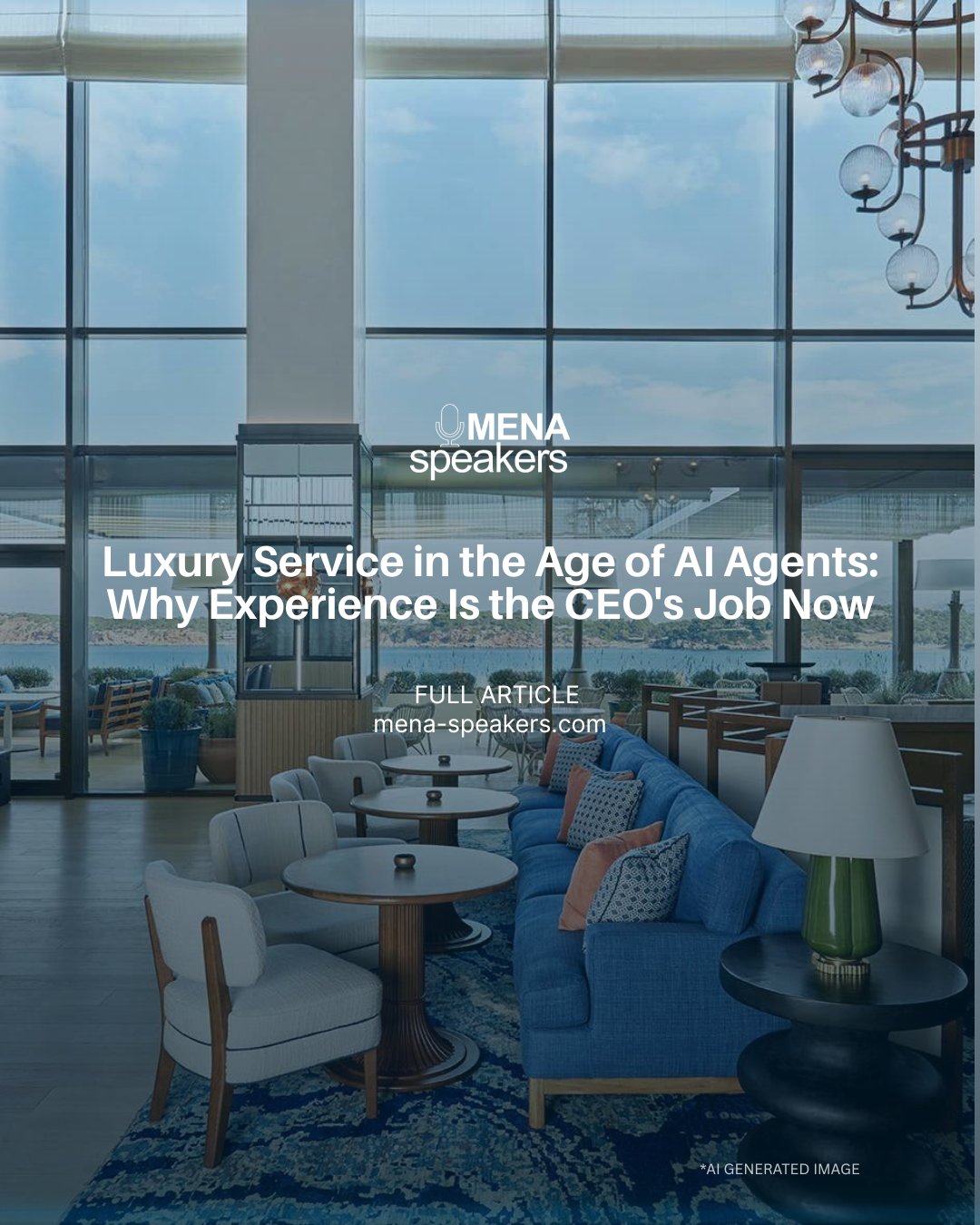
The organisations that treat this moment correctly won't choose between AI and human service, they'll be deliberate about which moments belong to which. AI earns the volume: the instant answer, the 2 a.m. query, the routine transaction. Humans earn the relationship: the moment that requires judgment, discretion, and genuine care, the moment a customer remembers long after the interaction ends.
That means experience strategy can no longer sit three layers below the CEO in an org chart, delegated entirely to a VP of Customer Service with a chatbot budget. As AI absorbs the predictable work, the differentiated, trust-building work left over becomes a direct lever on brand reputation, customer lifetime value, and competitive advantage, which makes it, by definition, a CEO-level concern.
The machines are ready to handle the basics. The question for leadership is whether the humans left to handle everything else are being trained, empowered, and trusted the way The Ritz-Carlton trained its own, or whether that responsibility has quietly been left to chance.
MENA Speakers connects event planners and organisations across the region with keynote speakers whose expertise in customer experience, leadership, and service culture is proven, current, and matched precisely to the demands of your event. Contact us at info@mena-speakers.com or +971 54 995 4166.